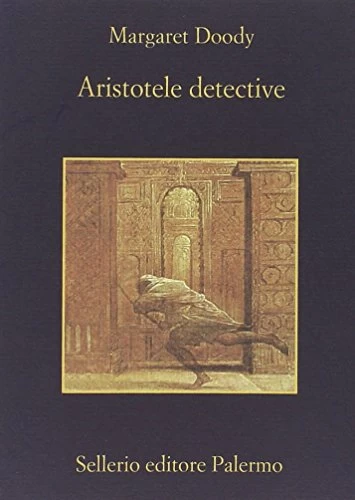
Aristotle Detective
Murder and mayhem may seem like unreasonable company for Aristotle, one of the founding minds of Western philosophy. But in the skilled hands of Margaret Doody, the pairing could not be more logical. With her Aristotle Detective novels, Margaret Doody brings a Holmesian hero to the bloodied streets of ancient Greece, trading the pipe and deerstalker of Sherlock for the woolen chiton and sandals of Aristotle. Replete with suspense, historical detail, and humor, and complemented by an ever-growing cast of characters and vivid descriptions of the ancient world, Doody ́s mysteries are as much lively takes on the figures and forms of the classics as they are classic whodunits in their own right. In Aristotle Detective, we first meet Stephanos ́naive Watson to Aristotle ́s learned Holmes ́a young landed Athenian and student of Aristotle. With the aid of his cunning, olive-loving teacher, Stephanos must clear his exiled cousin of murder and save his family ́s honor in a tense public trial. Will Stephanos survive to cinch the case? . '
Readers also enjoyed
Margaret Anne Doody
Margaret Doody, John and Barbara Glynn Family Professor of Literature and the first Director of the Ph.D. in Literature Program, is interested in literature of many languages and cultures. Her career is rooted in the study of the eighteenth century; she is the author of many articles on writers including Swift, Sterne and Austen, and of book-length studies of Samuel Richardson and of Frances Burney, as well as The Daring Muse: Augustan Poetry Reconsidered (Cambridge UP 1985; reissued 2010). Her interests have broadened in pursuit of the Novel in its many developments as a form, and she is attracted to the function and nature of stories, and to the work done through the ages by fantasy. Margaret Doody is best known internationally for The True Story of the Novel (Rutgers UP, 1996), and is a constant participant in international conferences on the ancient novel. Her most recent book, Tropic of Venice (University of Pennsylvania UP, 2006), takes a city as a text. She has received an NEH fellowship (2007) for a project tracing the roots of the Enlightenment in the Renaissance, dealing with thinkers such as Pico and Paracelsus; her book in progress is an enquiry into when and how we began to think positively of change as a good thing. The working title is “Love Change and Chaos: the Coming of the Enlightenment”.
Aristotle detective
Crime fighting in ancient Greece, stories narrated by former pupil Stephanos playing Watson to Aristotle’s Holmes.
Aristotle detective consists of three primary books, and includes one additional book that complement the series but is not considered mandatory reads. The current recommended reading order for the series is provided below.