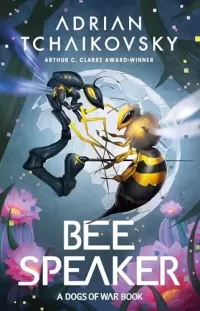
From the Arthur C. Clarke award winner, Adrian Tchaikovsky, comes the third instalment of the DOGS OF WAR science fiction series, a future where genetically engineered “Bioforms” have inherited not the Earth, but the Solar System.
The end of the world has been and gone.
There was no one great natural disaster, no all-consuming world war, no catastrophic pandemic. Only scores of storms, droughts, and selfish regional conflicts. Humanity was not granted a heroic end. Instead, it bled to death from a thousand cuts.
But where Earth fell apart, Mars pulled together. Engineered men and beasts,
aided by Bees – an outlawed distributed intelligence – survived through co-operation, because there was simply no alternative.
Fast forward to today. A signal – 'For the sake of what once was. We beg you. Help.' – reaches Mars.
How could they refuse? A consortium of Martian work crews gather the resources for a mission: a triumphal return to the blue-green world of their ancestors. And now here they are – three hundred
million kilometres from home.
And it has all already gone horribly wrong.
The series
In a future where the line between soldier and weapon has been erased, engineered creatures—called bioforms—are bred for war, designed for obedience, and optimized for destruction. But what happens when one of them begins to ask why?
Read full series description
Told with chilling intimacy and unsettling foresight, Dogs of War explores the mind of Rex, a loyal canine-shaped bioform built to follow orders without question. He’s part dog, part machine, and entirely lethal. Yet buried beneath the armor and programming lies a flicker of something more—a growing awareness of morality, identity, and the terrifying freedom of choice.
Set against a backdrop of corporate warfare, technological overreach, and a world reckoning with the consequences of its creations, this gripping speculative fiction series doesn’t just imagine a future shaped by biotech—it forces us to question who gets to define humanity in that future. As the story unfolds, so too does Rex’s transformation—from a loyal war dog to something dangerously close to sentient, and far less predictable.
With a tone that is equal parts philosophical and brutal, the series weaves themes of autonomy, loyalty, and the ethics of artificial life into a taut narrative that feels disturbingly relevant. Tchaikovsky’s storytelling is both visceral and cerebral, capturing the tension between evolution and control in a world teetering on the edge of its own making.
Perfect for fans of thought-provoking military sci-fi and bioethics-infused dystopias, this series doesn’t offer easy answers—just hard questions, unforgettable characters, and the kind of moral unease that lingers long after the final page.


Be the first reviewer
Sign in and write the first reader review.