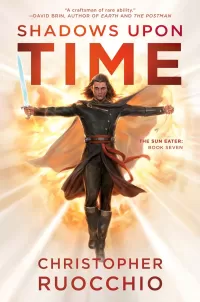
The seventh and final novel of the galaxy-spanning series merges the best of space opera and epic fantasy, as Hadrian Marlowe at last lights the greatest fire humanity has ever seen
Ambitious universe-building combines with intimate character portraits for storytelling on a truly epic scale—for fans of Orson Scott Card, Adrian Tchaikovsky, Patrick Rothfuss and Jack Campbell
The trumpet sounds.
The end has come at last. After his victory at Vorgossos, Hadrian Marlowe finds himself a fugitive, on the run not only from the Extrasolarians, but from his own people, the Sollan Empire he betrayed—and who betrayed him. Hidden safely beyond the borders of human space, Hadrian awaits the arrival of the one ally he has left: the Jaddian Prince Kaim-Olorin du Otranto.
What's more, the inhuman Cielcin have vanished, unseen for more than one hundred years. The armies of men have grown complacent, but Hadrian knows the truth: the Cielcin are gathering their strength, preparing for their final assault against the heart of all mankind.
Only Hadrian possesses the power to stem the tide: an ancient war machine, forged by the daimon machines at the dawn of time. The mighty Demiurge. With it, Hadrian must face not just the Cielcin horde, but their Prophet-King, and the dark gods it serves—the very gods who shaped the universe itself.
This must be.
The series
In The Sun Eater series, Christopher Ruocchio crafts a universe that feels both ancient and far-reaching, where the weight of history is always in motion, and every choice reverberates across millennia. Set in a future where the stars themselves seem to burn with the fury of gods, this epic saga blends the grandeur of space opera with the deep philosophical undertones of classic literature.
Read full series description
At the heart of it all is Hadrian Marlowe, a complex anti-hero whose journey from a seemingly unremarkable soldier to a key player in the galaxy's most monumental battles is anything but predictable. His tale is one of power, fate, and sacrifice, as he struggles not only against enemies across the stars but also with the immense cost of his actions. The series explores themes of loyalty, the corruption of power, and the search for identity within the shadow of overwhelming destiny.
The worlds in The Sun Eater are rich in detail—vast, ancient empires that echo the politics and betrayals of our own history. Ruocchio's prose weaves these landscapes together with a sense of inevitability, as though each planet, each star, is part of a grand design that the characters can only hope to understand. It’s a universe where civilizations rise and fall, and the very idea of heroism is tested at every turn. Each book pushes the boundaries of space-faring adventure, exploring not just the physical but the existential implications of war, empire, and humanity itself.
The series stands out for its meticulous world-building and a style that draws deeply from history, myth, and the weighty questions of philosophy. Ruocchio’s approach doesn’t shy away from the darker aspects of existence, giving the narrative an intensity and gravitas that resonate long after the pages are turned. With each book, readers are drawn deeper into a story that is as much about the human condition as it is about space battles and intergalactic intrigue.
With critical acclaim for both its intricate storytelling and its profound thematic exploration, The Sun Eater series has become a standout in contemporary speculative fiction. Whether you're new to the saga or a longtime fan, the journey through its stars promises to challenge, provoke, and, above all, captivate.



Be the first reviewer
Sign in and write the first reader review.