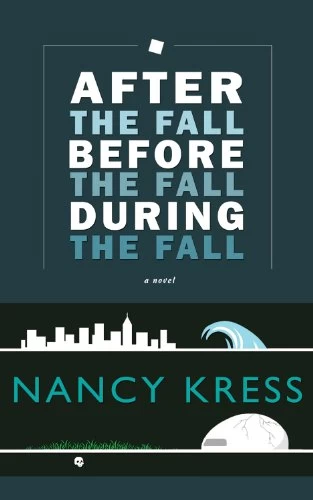
You have to admire author Kress' acumen in taking a currently overstretched plotline—EOTW—and tidily tying it into a fresh and fascinating knot. After the Fall, Before the Fall, During the Fall is an ingenious way to tell a tale: start three stories, all with different time lines, entwine them until they coalesce while saturating with different leitmotifs—apocalypse and alien invasion—all the while braiding in emotional and sociological character-driven concerns. And making it a page grabber while you're at it.
Of the three plot strings, the futureset of 2035 is the most fascinating, albeit the most difficult to conceptualize. It focuses on apparently the last struggle of humanity that is locked in a complex plastic prison of stark white corridors and rooms nicknamed The Shell. They are the refugees of a war against alien invaders called the Tesslie. The essential needs are surmounted the same way you'd treat your pet hamster. Most inmates feel they are lab specimens, something like the human incarceration of 1969's Slaughterhouse Five. But instead of just two, there are a handful of humans of all ages, but the attrition rate is higher than new births; hence The Grab, a gimcrack that transports a passenger back in time, but only for 10 minutes. On rotation, it becomes the job of the few teenagers to grab what they can from the past, depending on where they land. Grocery stores are good, Wal-Mart even better, but the most coveted destination of all is the ones that allow for the kidnapping of human babies.
They are playing against the biggest odds of all for the survival of the human race.
The time traveling is always to the same segment—realtime, like 2014—which is also the timestream of the second plotline. Julie Kahn is a computer scientist who has discovered a pattern of unexplainable kidnappings and burglary. Working with the FBI, her predictive algorithms are sourcing future sites, similar to the projections of Roger Mexico in 1973's Gravity's Rainbow to find the next V-2 rocket hit in WWII's London . Julie's world is complicated by a child from her now-estranged lover, a married man, who is still around her in the workplace. She is “caught as always in the rich stew of love, exasperation, fatigue, and joy that was motherhood”(p.97).
The third timestream is sans characters and follows the mutated bacterium that destroys all plant life above tide level. This triggers under-ocean magma plates to shift and volcanoes and cauldrons to spew, which causes the 200-ft high megatsunamis that drowns most land masses. World governments think it's a terrorist attack and fire nuclear rockets at the enemies. Conclusion? Looks like mass destruction of all plant and animal life, all of it happening offthepage.
In the end, Julie meets up with Pete, the 15-year-old main Grabber, explains that it is not Tesslies—she uses the convincing argument, “we humans always blame the wrong ones”(p.174)—and fumbles out the Gaia theory with, “we poisoned the Earth and raped her and denuded her. We ruined the oceans and air and forests, and now she is fighting back”(p.172). She hands Pete her baby but can't go herself because it is major deus ex machina from this point on, and Pete rides the gold sparklers back to 2035 just in time to join the exodus out of the Shell and onto a habitable Earth.
Finishing the novel, I wondered how author Kress could win the Nebula award for this novella. But, more importantly, I am curious how author Kress thought she could get away with not explaining her most essential plot device. The novel starts out strong with unique storytelling, passable characters, a great dangling carrot of intrigue and suspense, but then it bows under the shadow of a huge question mark so implausible it's scary. Timeline travel is all screwy, the Tesslies are met but never explained, and you can't jumpstart a whole species with only a dozen or so people, most of them sterile. Is the implication that futurepeople save them, thereby saving themselves?(1) Hell, that's a dilettantish trap. Maybe the Tesslies just happened to be swooshing around our solar system looking for a drive-in theater, saw Earth's disaster, and decided to help out. Yeah. I mean, with all the science paraded around to describe this absolute cataclysm, what seems to be left to account for the Shell and its machinery is “it's not mysticism, it's Darwinian self-preservation. Maybe Gaia will start over. Maybe you in the Shell are part of that!”(p.174). This is explaining something by praising its contradiction.
Which is no explanation at all.
1) Do I really have to reference Varley's great story, 1977's Air Raid, then later expanded by Varley to 1983's Millennium, later turned into the movie 1989's Millennium? And nary a single award—although nominated—for this timetravel masterpiece.