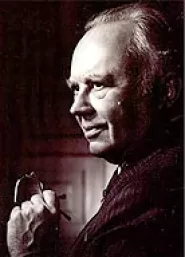
Edited, with an introduction, by John Pelan. Jacket art by Russell Kirk.
The Classical ghost story is traditionally though of as a very
British pursuit, a genre which was both influential and popular for more than a century,
but which reached its peak and began a steady decline midway through the twentieth
century. The American writer Russell Kirk would therefore seem to be an unlikely candidate
to assume the mantle of such authors as Sheridan Le Fanu and M. R. James: his first
collection of short stories, The Surly Sullen Bell, was not published until 1962,
with further collections of stories appearing in 1979 and 1984.
Yet Kirk easily and gracefully took the classic ghost story,
infused it with his own cosmopolitan outlook and conservative nature, and demonstrated
that it was by no means a dead or even dying genre, but one that could speak of ancient
fears, remorseless evil, and quiet courage in a modern world that would seem to have no
room for such things. His stories begin with a deceptive calm, in which ordinary people go
about their everyday tasks; but soon his protagonists face choices which will forever mark
their characters (should they survive) or their souls (should they not). Kirk called his
stories 'experiments in the moral imagination;, and time and again he demonstrates how the
seemingly isolated actions and choices of one person have echoes which resonate far beyond
their immediate situation. This is evident in one of Kirk's most famous tales, 'There's a
Long, Long Trail A-Winding', which in 1977 won the World Fantasy Award for Best Short
Story.
In his introduction to this, the first of two volumes for
Ash-Tree Press collecting together Russell Kirk's short supernatural fiction, editor John
Pelan discusses the author's works, pointing out the connections between Kirk's short
stories and novels, which together form a complex tapestry of recurring characters,
settings, and themes. Also included is Kirk's essay 'A Cautionary Note on the Ghostly
Tale', in which the author writes that his stories are inhabited by 'retributive ghosts,
malign magicians, blind angels, beneficent phantoms, conjuring witches, demonic
possession, creatures of the twilight, divided selves... But let me say also that my
bogles are not to be taken lightly.' On a more hopeful note, however, he affirms his
belief — demonstrated in his stories — that dark powers do not rule the universe;
that 'by bell, book, and candle, symbolically at least, we can push them down under.'
Contents:
- Introduction — 'The Ghosts of Piety Hill — by
John Pelan
- The Surly Sullen Bell
- Behind the Stumps
- Sorworth Place
- Balgrummo's
Hell
- There's a Long
- Long Trail A-Winding
- Saviourgate
- Off the Sand Road
- Fate's Purse
- The Princess of All Lands
- An Encounter by Mortstone Pond
- Lex Talionis
- A Cautionary
Note on the Ghostly Tale (essay)