
The Fall of Chronopolis
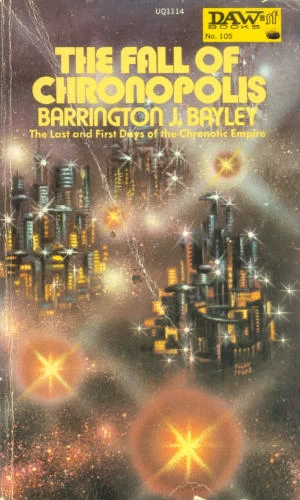
The Fall of Chronopolis is also known as Chronopolis.
There is real time... and there is potential time.
By controlling the difference, the Chronotic Empire came into existence and maintained itself over a thousand years of human history. Its Time Fleets, armadas of time-travelling fortresses, patrolled its temporal borders relentlessly, blotting out potential-time deviations, erasing errors of history that might undermine the empire.
But nevertheless the empire's days were numbered, for somewhere in its own future was the century of the Hegemony, its implaccable enemy.
Barrington J. Bayley, author of Collision Course, once again demonstrates in this brilliantly different novel, his ability to weave unusual concepts of time with the human problems of the men and women caught up in the contradictions of a destiny no mortal could ever comprehend.
Readers also enjoyed



Barrington J. Bayley
Barrington J. Bayley (1937–2008) was a British science fiction writer. He was born in Birmingham and educated in Shropshire. He died of complications from bowel cancer on October 14, 2008.
Bayley worked a number of jobs before joining the Royal Air Force in 1955. His first published story, "Combat's End", had seen print the year before in Vargo Statten Magazine.
In the 1960s, Bayley's short stories featured regularly in New Worlds magazine and then later in various New Worlds paperback anthologies, becoming friends with New Worlds editor Michael Moorcock and joining science fiction's New Wave movement. His first book, Star Virus, was followed by more than a dozen other novels; his downbeat, gloomy approach to novel writing has been cited as influential on the likes of M. John Harrison, Brian Stableford and Bruce Sterling.
More books by Barrington J. Bayley


