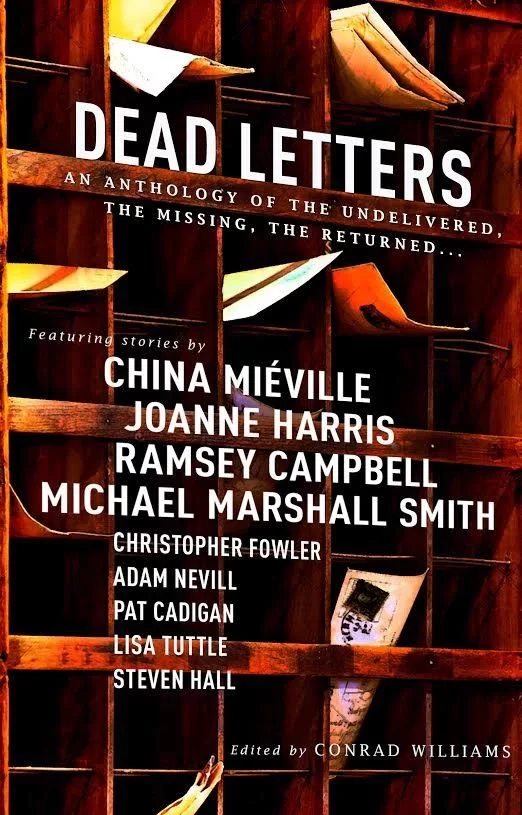
 Dead Letters (edited by Conrad Williams) was published by Titan Books in April 2016.
Information about the editor:
Conrad Williams has written seven novels, four novellas and a short story collection. One won the August Derleth award for Best Novel in 2010, while The Unblemished won the International Horror Guild Award for Best Novel in 2007 (he beat the shortlisted Stephen King on both occasions). He won the British Fantasy Award for Best Newcomer in 1993, and another British Fantasy Award for Best Novella (The Scalding Rooms) in 2008.
Click here to visit the editor's official website.
Information about Dead Letters:
The Dead Letters Office: the final repository of the undelivered. Love missives unread, gifts unreceived, lost in postal limbo. Dead Letters: An Anthology features new stories from the masters of horror, fantasy and speculative fiction, each inspired by an inhabitant of the Dead Letters Office, including tales from Joanne Harris, China Miéville & Maria Dahvana Headley, Adam LG Nevill and Michael Marshall Smith.
A REVIEW OF DEAD LETTERS (EDITED BY CONRAD WILLIAMS)
Conrad Williams has come up with an original idea for Dead Letters, because he has gathered a good and versatile selection of stories about undelivered, missing and returned letters. This is something that has never been done before (I don't recall hearing anything about similar kind of anthologies).
I think that all of us - or most of us - have experiences about letters and packages that have disappeared into the postal limbo and have never found their way to the recipients. There's nothing we can do about this, but accept that unexpected things may happen to our letters when they're posted. If you're curious about what happens to these letters, you'll get some insight into this matter when you read Dead Letters, because each of the stories reveals something new about undelivered letters.
I was pleasantly surprised by this anthology, because it's one of the most original anthologies I've ever read. I've read a few stories about lost and undelivered postal deliveries, but I've never read so many good and imaginative stories about such deliveries. The authors have clearly done their best to write memorable stories that showcase their distinct literary voices, writing skills and imagination.
Dead Letters contains the following stories:
- “The Green Letter” by Steven Hall
- “Over to You” by Michael Marshall Smith
- “In Memoriam” by Joanne Harris
- “Ausland” by Alison Moore
- “Wonders to Come” by Christopher Fowler
- “Cancer Dancer” by Pat Cadigan
- “The Wrong Game” by Ramsey Campbell
- “Is-and” by Claire Dean
- “Buyer’s Remorse” by Andrew Lane
- “Gone Away” by Muriel Gray
- “Astray” by Nina Allan
- “The Days of Our Lives” by Adam LG Nevill
- “The Hungry Hotel” by Lisa Tuttle
- “L0ND0N” by Nicholas Royle
- “Change Management” by Angela Slatter
- “Ledge Bants” by Maria Dahvana Headley & China Miéville
- “And We, Spectators Always, Everywhere” by Kirsten Kaschock
All of these stories are original to this anthology, and each of them has been inspired by an object from the Dead Letters Office. Their contents range from undelivered letters and love affairs to family secrets and strange lifeforms. They're effective and thought-provoking stories filled with difficult themes and issues concerning life, work, family, secrets, love and relationships.
Because many of the authors are masters of contemporary dark fiction and have experience about writing different kinds of speculative ficton stories, their stories are fascinatingly dark and strange. There's a dark, macabre and wistful edge to their stories that will please readers of dark fiction.
It's great that Conrad Williams has given speculative fiction authors an opportunity to write stories about dead letters, because they have plenty of imagination and they're capable of writing emotionally touching and harrowing stories. I don't mean to belittle literary fiction authors, but I've noticed that speculative fiction authors are more capable of delivering literary stories that have a direct impact on readers and what's best, speculative fiction authors dare to write unflinchingly and honestly about difficult themes and issues (their stories have brutal honesty).
Here's a bit more information about these stories and my thoughts about them:
“The Green Letter” by Steven Hall:
- A story about the green letter that mysteriously arrives in mailboxes at a certain time. Every green envelope contains only one item - a list that has ten points on it. When one of the points is circled, something happens to the recipient.
- This is a fascinatingly weird story with an unsettling undertone.
“Over to You” by Michael Marshall Smith:
- In this story, a man receives an envelope that has been addressed to another person. He opens and finds a chess piece and a short sentence. Soon he notices weird things.
- An excellent story about a man who's trying to reduce smoking, because his son wants him to quit smoking.
“In Memoriam” by Joanne Harris:
- A story about CEW (Customer Experience Worker at the National Returns Centre for the UK) who opens a letter addressed to him and finds a picture of himself with other persons.
- A well written and wistful story about memories and family ties.
“Ausland” by Alison Moore:
- In this story, Karla meets his childhood acquaintance, Lukas, again after many years. She wants to show him a few photographs.
- I enjoyed this story very much, because the author writes well about what happens when Karla and Lukas meet each other again.
“Wonders to Come” by Christopher Fowler:
- A story about Roy who wonders what caused a hotel construction to miss its deadline. What Roy finds out is something unexpected.
- A well written science fiction story featuring a new lifeform.
- This is one of the best stories in this anthology.
“Cancer Dancer” by Pat Cadigan:
- A woman who hears that she has only two years left to live because of uterine cancer. She gets an envelope that is addressed to a detective sergeant and becomes interested in its contents.
- The author writes well about the cancer patient's feelings and life.
“The Wrong Game” by Ramsey Campbell:
- This is an interesting piece of fiction, because the author addresses the editor of this anthology in an intriguing way with a dash of wittiness.
- This story has a good atmosphere that becomes increasingly interesting as the story unfolds.
- One of the best stories in this anthology.
“Is-and” by Claire Dean:
- In this story, the protagonist and her partner, Gareth, travel to an island and meet Gareth's mother. Soon Gareth receives a mysterious parcel.
- An excellent and atmospheric story with references to old beliefs and Celtic folklore.
- This is one of my favourite stories in this anthology.
“Buyer’s Remorse” by Andrew Lane:
- The protagonist receives a letter by mistake and wonders how he could deliver it to its intended recipient. He begins to search for the place where the recipient is supposed to live and finds himself in trouble.
- This story is satisfyingly Lovecraftian and unsettling. The author writes excellently about a lost, isolated and ignored place where cosmic evil has gained a foothold.
- An excellent story.
“Gone Away” by Muriel Gray:
- This story's protagonist receives a returned letter that has no address on it. She becomes interested in the letter and its contents.
- The author writes fascinatingly about the protagonist's relationship with her grandfather.
- A well written story with intriguing mystery elements.
“Astray” by Nina Allan:
- Aileen is mesmerised by letters that arrive at their house, but are addressed to a person who doesn't live there. These letters have an effect on her life.
- This story gradually grows into a disqueiting tale of obsession concerning other people's lives and fates.
- The author's descriptions about the protagonist's life are vivid and realistic, and the conversations between her and Selena are excellent.
- An excellent - and perhaps the best - story in this anthology.
“The Days of Our Lives” by Adam LG Nevill:
- A fascinatingly unsettling portrayal of a macabre marriage.
- The author writes strikingly about the protagonist's difficult and twisted relationship with Lois.
- Along with Nina Allan's story, this is one of the best and most memorable stories in this anthology. Once you've read it, it's quite difficult to forget it.
“The Hungry Hotel” by Lisa Tuttle:
- A beautifully written story about a woman who has an affair while her boyfriend is out of town.
- I was impressed by this story and its atmosphere, because the protagonist had to deal with her feelings towards the man she met.
- This is one of the most intriguing stories I've ever read about love and infatuation.
“L0ND0N” by Nicholas Royle:
- A story about an editor, Nick, who is stalked by a man called Ian. Because Nick reads Ian's novel and finds it interesting, he thinks about publishing it.
- A fascinating story that offers readers a glimpse into the life and choices of an editor. It was interesting to read about how Nick felt about Ian and his novel and how he weighed different things.
“Change Management” by Angela Slatter:
- Eva, who works at the Dead Letter Office, is a "solitary little mouse". Her life changes when she steals a letter that has been sent by a woman called Lucy to her brother, Jonathan.
- An excellent story with a memorable ending.
“Ledge Bants” by Maria Dahvana Headley & China Miéville:
- This story is wonderfully different, because it tells of Merlin who works at the Dead Letters Office and hunts for his scattered magic.
- I was positively surprised by this story and its originality, because I didn't expect to find this kind of a story in this anthology.
- A truly original and intriguingly whimsical take on Arthurian fiction.
“And We, Spectators Always, Everywhere” by Kirsten Kaschock:
- A frighteningly effective and unsettling glimpse into the life of a boy called Gibb and his caretakers.
- I was impressed by the author's way of writing about Gibb's childhood and what happened to him when he grew up.
- An excellent story that will haunt your mind for a long time after you finish reading it.
Michael Marshall Smith's “Over to You” is a powerful story about a chess piece that causes puzzlement. In my opinion, “Over to You” is a good example of a story that feels ordinary, but is in fact quite extraordinary - it's intriguing storytelling at its best.
Claire Dean's “Is-and” is one of the best stories I've had the pleasure of reading this year. It's a compelling story about a couple who visit an island. I was intrigued by the author's way of adding folklore elements to the story, because they worked well and enhanced the atmosphere.
Andrew Lane's “Buyer's Remorse” is an excellent Lovecraftian weird fiction story with a distinct feel of something strange and threatening, because the protagonist is fascinated by lost and ignored places. This story has a feel of classic weird fiction to it, because the author evokes haunting images of hidden places where unspeakable things happen.
Muriel Gray's “Gone Away” deserves a special mention as a story with interesting mystery elements. I was impressed by the author's way of writing about the protagonist's relationship with her grandfather.
Nina Allan's “Astray” is a haunting and beautifully written story. What I like most about this story is that it gradually grows into a compelling and disquieting story with a harrowing ending. All of the different elements in this story form a narrative that gives readers a glimpse into the protagonist's life and highlight her obsession with what she has learned from a letter that was accidentally delivered to her. The beautiful prose emphasises the story's atmosphere and emotional depth.
Adam LG Nevill's “The Days of Our Lives” is the most disturbing story in this anthology. It features a captivatingly twisted glimpse into a relationship that is anything but normal and healthy. The author writes unflinchingly about what Lois does and how she reacts to various things. I consider this story to be a masterpiece of modern dark fiction.
Angela Slatter's “Change Management” is a dark and fascinating story about change. The protagonist, Eva, is described as a person who enjoys being alone and avoids socialising at work. When change comes into her life, it's almost like a force of nature that transforms her from a quite mouse to a much stronger and more determined woman. The author's approach to change feels powerful, because she pays attention to Eva's life, feelings and fears.
I enjoyed reading Dead Letters and found all of the stories intriguing and well written. It's a fine anthology of versatile stories that inhabit the space between literary fiction and speculative fiction. It will delight readers who enjoy well written fiction and strange stories, because each of the stories is something different and special.
What makes this anthology especially intriguing is that it will be of special interest to readers who have personal experiences about lost letters and packages. If you've ever lost anything that you've sent or haven't received something that you've expected to arrive in your mailbox, you'll most likely find these stories very interesting and will enjoy them.
My final words are:
Dead Letters is an excellent anthology of dark, wistful and thought-provoking stories for adults - highly recommended!