
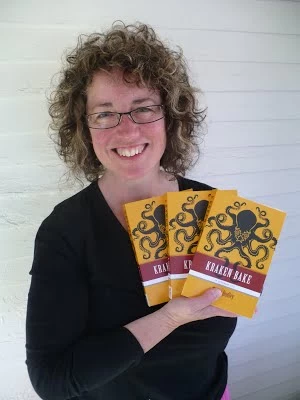
 Risingshadow has the honour of publishing a guest post by Karen Dudley.
Karen Dudley is the author of Food for the Gods and its sequel, Kraken Bake.
Information about the author in her own words (from the author's official website):
"I am tweaker of words, a procrastinator of work, a scribbler of novels, and a maker of gourmet meals. I am also a mum, which is more work than all of the above put together. Great perqs though!
My checkered past includes field biology, production art, photo research, palaeo-environmental studies, editing, archaeology and Classical Studies. Needless to say, I just couldn't seem to settle on one job and sometimes I thought there was something wrong with me - a sentiment echoed by my mum. Then, a number years ago, an epiphany! I finally realized that what I really wanted to do was... everything! And if you want to do everything, the best way to do it is to be a writer.
I have discovered that I'm happiest sitting at my computer in my pink leopard fleece footie pajamas (now there's a troubling mental image for you!) creating imaginary worlds and people. I am now doing everything and living in Winnipeg with my urban planner/librarian/professor husband (who has his own career identity problems), our lovely daughter, and assorted very nice but occasionally evil-minded cats.
I wrote four environmental mysteries and a short stack of wildlife biology books for kids before I had another epiphany... I want to write fantasy! So I did. Food for the Gods* is an historical fantasy novel set in ancient Athens. It's all about chefs and gods and food and murder and strange beasties and a huge amount of fun. Think Gordon Ramsay in ancient Greece with a generous dollop of the fantastical and you're starting to get the picture."
Click here to visit the author's official website.
GUEST POST by Karen Dudley
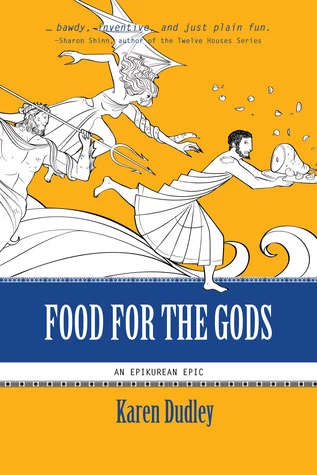 I am often asked where I get my ideas from. It is probably the most frequently asked question of authors. For Food for the Gods and its sequel, Kraken Bake, serendipity played a large role in their genesis. You see, a number years ago, I was sitting around one day thinking about the Greek myth of Tantalus (yeah, writers really do sit around thinking about weird stuff like that. They also really do write in their pajamas. Trust me.)
For those of you who may not be familiar with this myth, Tantalus was the King of Lydia. The guy had it all: wealth, kingdom, kids, gods for friends. But of course, in true Greek tragic fashion, none of that is quite enough for our friend Tantalus. He thinks he should be kicking back on Mount Olympus with his divine chums, and he gets into a fair bit of trouble because of it. There are several variations of the myth about what Tantalus does. In one of the more famous versions, he invites all the gods ‘round for a feast, then he kills his own son, Pelops, chops him into bite-sized pieces and serves him to the gods for tea.
The gods, being their usual omniscient selves, naturally realize right away what Tantalus has done, so none of them eat anything—none, that is, except the goddess Demeter. At this point in the myth cycle, she’s distracted and not thinking too clearly, and she ends up pulling up a cushion on the dining couch and having a bit of a nosh.
The rest of the gods confront Tantalus with his crime and punish him by sending him straight to the underworld. There, they chain him to a tree, cursing him at the same time with everlasting thirst and hunger. There’s a pool of water at his feet, but every time he bends to take a drink, the waters recede. There are fruits hanging from the branches of the tree, but every time he reaches up to pluck one, a breeze comes up and blows them out of his reach. For all you word nerds out there, this myth is actually where we get our verb ‘to tantalize’ from.
After they finish chaining Tantalus to the tree, the gods very kindly reconstitute Pelops, but because Demeter ate part of the ‘Pelops stew’, they have to give him an ivory shoulder to replace the old one.
 Well, I was sitting there that day thinking about Pelops and what happened to him, and I started wondering what that experience would do to somebody. And what happens to poor old Pelops afterwards? And wouldn’t he make an interesting protagonist. I mean, here’s a guy with the proverbial chip on his shoulder. So I knew at that point, I wanted to write about Pelops. Oh sure, the myth continues on with him—where he goes and what he goes on to do etc.—but not in a way I found particularly interesting. I wanted to tell my own version of his story. What happens to Pelops after all this?
I’ve always had a fascination for science and inventions, so I thought at first I might make Pelops a student of Archimedes, the famous Greek engineer and inventor. If I did that, I could write about some of the more interesting inventions of ancient Greece. But somehow, it just didn’t feel quite right. This is where serendipity comes into it. I was leafing one of our reference books—a history book called The Life of Greece by Will Durant, when I came across a line that said in ancient Athens when people wanted a special dinner, they couldn’t go to a fancy restaurant, because they didn’t exist yet, so what they would do was hire the services of a professional cook, who was usually a foreigner.
Bingo. Or, more appropriately, Eureka!
After reading that single sentence, I had my protagonist (Pelops), I had the city that he lives in (Athens), I had his profession (celebrity chef), and I had the title of the first book: Food for the Gods. After all, that’s what he does and that’s what he was.